
County takes stand against 765-KV Power line

County had about 30 days of awareness, compared to 306 days in southern counties
Shackelford County commissioners moved quickly last week to oppose a proposed high-voltage transmission line that could cross portions of the county, adopting a formal resolution during a specially called meeting on Friday after local landowners Mark Moon and Robert Montgomery warned commissioners at the March 9 regular meeting that they are entering the regulatory process months later than other affected areas.
Around 20 landowners attended the March 13 emergency meeting of the Shackelford County Commissioners Court to express concerns about the proposed Dinosaur–Longshore 765-kilovolt transmission line project planned by Oncor Electric Delivery.
Following discussion with residents, commissioners unanimously approved a resolution opposing the proposed route through Shackelford County and raising concerns about potential impacts on property values, agriculture, county infrastructure and emergency communications systems.
The resolution was directed to the Public Utility Commission of Texas, the state agency that will ultimately decide the route of the transmission line. Copies of the resolution will also be sent to Governor Greg Abbott, U.S. Senators John Cornyn and Ted Cruz, Congressman Jodey Arrington, State Senator Phil King and State Representative David Spiller, along with representatives of Oncor.
In the resolution, commissioners cite concerns about potential impacts to agricultural operations, property values and rural infrastructure, as well as the possible effects large transmission structures could have on county roads, water resources and emergency communication systems. The document also states that county officials believe the proposed routing alternatives through Shackelford County could cause long-term disruption to ranching and farming operations that form the backbone of the local economy.
If constructed, the line would use large steel lattice towers that can exceed 170 feet in height and require a right-of-way roughly 200 feet wide, according to project materials filed with the Public Utility Commission.
Timeline raises concerns
Much of the discussion during the meeting focused on when local residents first learned about the project compared with other counties along the potential route.
Oncor mailed large packets of documents related to the proposed routes to affected landowners on February 19, 2026. The packets contained 79 pages of project documents along with 11 large fold-out maps outlining the routing alternatives. Several residents said the materials did not arrive until days later, with at least one landowner, Art Viertel, reporting the packet was received around March 5. The mailings were sent out just 30 days before the March 23 deadline to file as an intervenor in the state regulatory case.
Public records show that residents in other counties learned about the project much earlier.
Utilities commonly hold these meetings during the early stages of major transmission projects to present preliminary route information and allow landowners and local officials to review maps, ask questions and provide feedback before the Public Utility Commission begins its formal review process.
Notices for those meetings were published in a number of regional newspapers in May 2025, almost a year ago, including the Brownwood Bulletin, Clyde Journal, Coleman Chronicle & Democrat Voice, The Comanche Chief, Eastland County Today, Midland Reporter-Telegram, Big Spring Herald, Sweetwater Reporter, San Angelo Standard-Times and the Abilene Reporter-News.
No notice appeared in The Albany News in May 2025, and no public meeting was held in or offered to Shackelford County, even though routing segments now under consideration include portions of the county. The only notice printed in The Albany News came later, on February 26, 2026, when a 23-page filing was published, the longest notice ever printed in the newspaper’s 150 year history.
Residents here say the absence of a local meeting meant Shackelford County landowners did not have the opportunity to review the project or raise concerns during the early stages of the routing process.
Maps associated with those 2025 meetings also did not show the route segments that now include Shackelford County.
As a result, residents here say the first time they learned about the project was the February 19 mailing.
Based on those dates, residents in other counties that participated in the June 2025 meetings had approximately 306 days to prepare before the March 23 deadline.
Shackelford County landowners had about 30 days.
That means local residents had roughly 9.8 percent of the preparation time available to communities farther south.
In a written response to questions from The Albany News, Oncor spokesperson Roxana Rubio said Shackelford County was incorporated into the formally proposed routes when the company filed its Certificate of Convenience and Necessity (CCN) application with the Public Utility Commission in February 2026.
Rubio said the routes presented during the June 2025 public meetings reflected preliminary routing options used during the early stages of the study and environmental review process.
Rubio said that once the CCN was filed, all affected landowners received the same formal notice and opportunity to participate in the regulatory case.
The company said that notification of the CCN application and formally proposed routes was issued to all affected landowners at the same time in February 2026.
“Every affected individual was informed of the formally proposed routes and ultimately had the same opportunity to intervene during the CCN proceeding,” the Rubio said.
Rubio also stated that it is not accurate to say landowners in counties involved in the earlier public meetings necessarily had more time or an advantage in the process.
“It is also not true that landowners on routes in other counties necessarily have had more time,” Rubio said in an email.
Residents in those areas became aware of the project during the May–June 2025 meetings, roughly nine months before Shackelford County landowners received notice. During that time, some landowners in those counties secured attorneys experienced in Public Utility Commission cases prior to the February 2026 filing.
Several residents told commissioners the shortened timeline is creating significant challenges, particularly when it comes to obtaining legal representation.
Attorneys who specialize in Public Utility Commission transmission cases are relatively few in number, and most all had already been retained by landowners and counties in areas that began organizing opposition months earlier, according to local landowner Mark Moon, who spoke at the March 9 commissioners meeting.
Moon told commissioners that many residents have struggled to find attorneys experienced in PUC transmission cases because several of the firms that handle such matters have already been retained by landowners in other counties where the project had been discussed for months.
“We talked to everybody, and the attorneys that fight the PUC all the time are already taken,” Moon said.
Earlier communication with county officials
Documents included in the project materials show that consultants conducting early routing studies for the transmission line contacted Shackelford County officials earlier in the process.
On December 10, 2024, letters were sent to the county judge and all four county commissioners requesting information about potential environmental or land-use constraints within the county.
Records included in the documentation show that Precinct 3 Commissioner Lanham Martin responded to the inquiry in January 2025.
According to the record of the conversation, Martin told project consultants there were no known environmental hazards or county-level restrictions that would prevent the line from crossing the county.
Shackelford County Judge John Viertel said the inquiry was a routine information request commonly sent to local governments during early routing studies to determine whether officials are aware of environmental issues or regulatory constraints that could affect a potential route.
Viertel emphasized that the exchange did not involve approval of the project, permission for the line to cross the county or any decision regarding the proposed transmission route.
He also noted that counties in Texas generally have very limited authority over land use on private property in unincorporated areas, and most environmental permitting and regulatory oversight related to transmission projects is handled by state agencies.
Four large binders containing extensive project documentation were delivered to the Shackelford County Courthouse on February 19, 2026, the same day many landowners began receiving mail packets about the proposed transmission routes. The binders, which contain hundreds of pages of maps, environmental studies and regulatory materials related to the project, were delivered by an Oncor representative and left with county officials. The representative did not remain long at the courthouse because he was responsible for delivering similar materials to 28 other counties, according to county employee Kim Russell.
Earlier meeting materials remain online, alongside current maps
During reporting for earlier coverage of the project, The Albany News reviewed materials posted on Oncor’s public website.
One of the maps on the project page was associated with the public meetings held in June 2025 and showed the study area used during those presentations.
The map did not include the route segments now proposed in Shackelford County.
When contacted by the newspaper, Oncor representative Rubio acknowledged in an email that the map was from earlier public participation materials and was no longer accurate.
Rubio asked where the newspaper had located the map on the website.
The Albany News provided the link to the location where the map appeared on the project page.
As of this week, the outdated map remained accessible on the project website without any notation indicating that it is no longer current. Updated maps showing the current routing alternatives are also available elsewhere on the same site.
The newspaper also contacted Oncor representative Rubio again while preparing this article to ask when Shackelford County was added to the routing alternatives and why the county was not included in the public participation meetings held in 2025.
The company did not directly answer those questions but provided general information about the routing process and notification requirements.
Distance and route questions
The proposed transmission project spans a large portion of Central and West Texas.
The straight-line distance between the project’s endpoints near Glen Rose and Big Spring is roughly 217 miles.
However, some routing alternatives extend significantly north of that direct path.
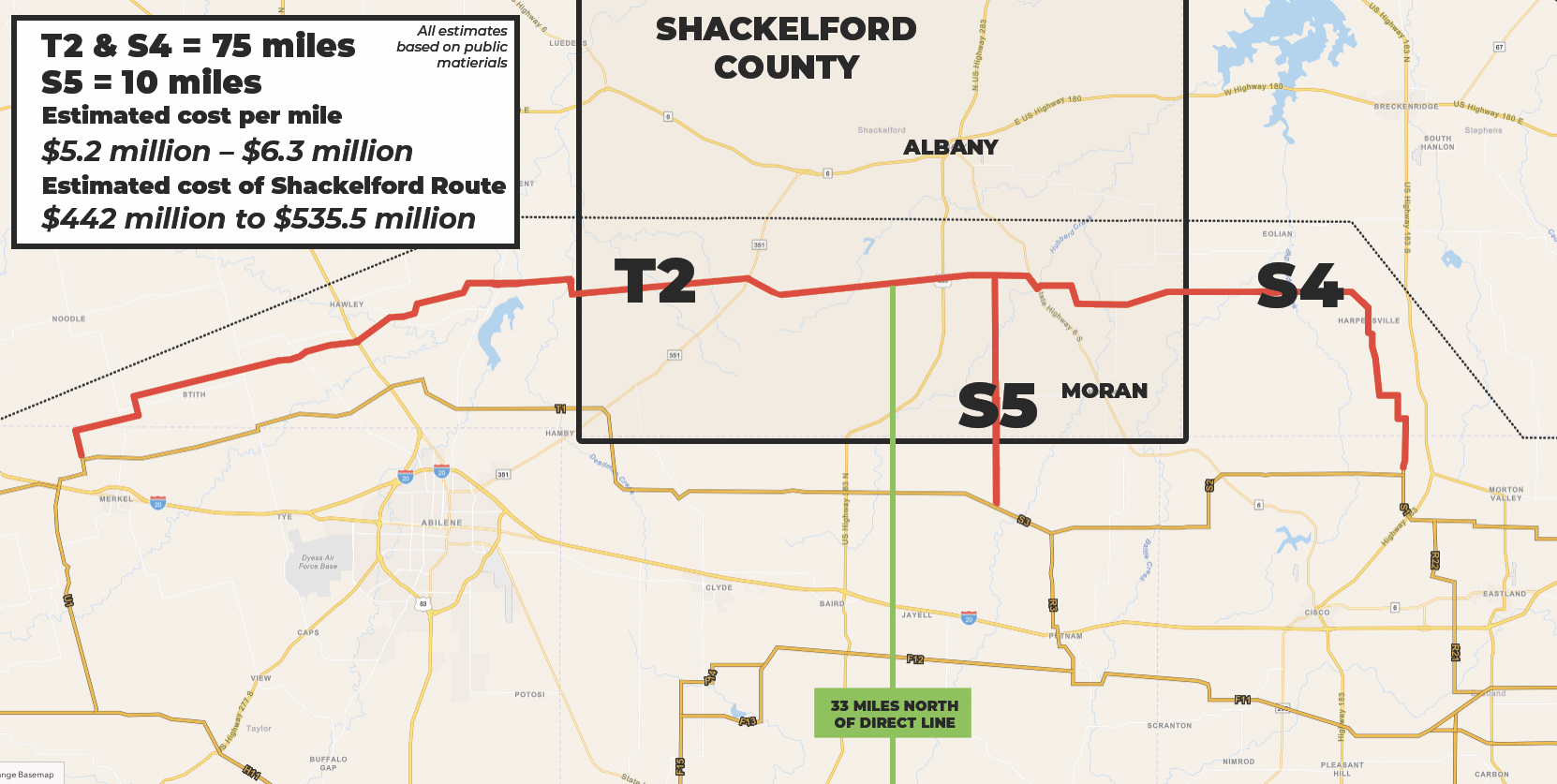
Maps included in the project filings show that route segments labeled T2, S4 and S5, which could cross Shackelford County, run as much as 30 miles north of the straight-line corridor between the two locations.
Those three segments alone account for roughly 85 miles of transmission line within the routing alternatives.
According to ERCOT and PUC transmission planning studies, constructing a single-circuit 765-kilovolt transmission line can cost roughly $5.2 million to $6.3 million per mile. (Source, https://interchange.puc.texas.gov/Documents/55249_7_1414447.PDF, page 3)
Using those figures, the northern segments that include Shackelford County could represent approximately $442 million to $535.5 million in construction costs, depending on final engineering and routing decisions.
Transmission infrastructure projects are typically financed by utilities and the costs are recovered over time through electric rates paid by customers.
Landowners describe impact
Several landowners spoke during March 13 meeting about the potential impact the transmission corridor could have on their property.
Robert Montgomery told commissioners the county appears to have entered the process long after other areas had already begun organizing.
“We’re kind of the last ones to the dance on this transmission line,” Montgomery said. “If there was ever an unfair fight, this is about as unfair as it gets.”
Steve Waller described the personal impact the route could have on his family.
Waller told commissioners he built his home himself on property he had long planned to retire on.
According to the proposed routing maps, two route segments converge on his property, placing the potential transmission corridor roughly 300 feet in front of his house.
“This home and land was our dream,” Waller said. “This is where we thought we would stay for the rest of our lives.”
In describing the broader fight facing local landowners, Waller later called it “a David and Goliath moment.”
“We are up against something far bigger than ourselves, but that does not mean we are without a voice,” he said.
He urged commissioners to take action on behalf of county residents.
“What I would ask of you as commissioners and leaders of our county is to file a protest,” he said.
Next steps
The Public Utility Commission will review the project and consider testimony from utilities, landowners and local governments before selecting a final route.
Individuals wishing to participate formally in the case must file requests to intervene before the March 23 deadline.
Editor’s Note:
Both staff members of The Albany News who contributed to this article, David H. Waller and Melinda Lucas, are related to individuals whose property may be affected by the proposed transmission routes. This article presents information based on public records, documents and meeting testimony and does not include opinion.
